


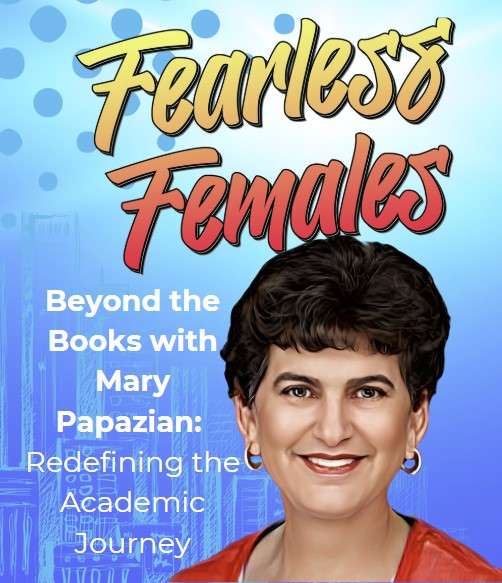
In this episode of Fearless Females, host Lorie Jones sits down with Dr. Mary Papazian, the executive vice president of the Association of Governing Boards for Universities and Colleges, to explore her inspiring journey in higher education.
From a literature-loving childhood to ascending to prominent academic administrative roles, including university presidencies, Mary shares the pivotal moments and decisions that shaped her impressive career. She discusses the importance of continuous learning, being open to unexpected opportunities, and maintaining work–life balance. She also touches on unique challenges faced by women leaders and offers invaluable advice to young women eager to carve their own paths.
Tune in to uncover the remarkable career insights of a seasoned leader dedicated to empowering the next generation of fearless females.
Show Highlights:
- Where to find our new fearless website. [00:35]
- The importance of receiving feedback on the path to presidency. [09:15]
- The power of asking to create your opportunities. [12:52]
- Why women in leadership must guard personal time. [14:32]
- The trustworthy advice vs. unsolicited tips difference. [16:14]
- How to navigate the complexity of firing colleague friends. [20:06]
- Advice on humility and diverse connections to kick start young professionals. [25:00]
- Self-care towards getting tenured as an academic. [28:55]
- Uncover gender-specific challenges in higher education. [33:15]
- Discover life’s art of embracing the present. [35:45]
Connect with Dr. Mary Papazian at https://www.linkedin.com/in/mary-papazian/.
If you enjoyed this episode, please go to Apple Podcasts and leave a review!
For more information about Lorie Jones, go to https://fearlessfinancialadvisors.com/fearless-females.
Please see below for the entire episode transcript

01:08.80
Lorie Jones
Good morning. We are here today with Dr. Mary Papazian. She is, and I'm going to get this title right, she is the Executive Vice President of the Association of Governing Boards for Universities and Colleges. Did I do it good Mary?

01:25.38
Dr. Mary Papazian
That sounds right to me.

01:31.83
Lorie Jones
Perfect. Well, let's get started. I'm so excited to hear your story. The very first question I ask will probably be one that you like because you're in education and it's about books. I'm a reader. I love any and all suggestions. What is your favorite book?

01:51.89
Dr. Mary Papazian
What is my favorite book? You're talking to a literature professor. So that's a dangerous, dangerous question. I'm going to answer it if I might with multiple examples. All right. So I'm going to take myself back to my childhood when we used to go to the library and pick up 10 books or whatever the library allowed us. And then we always had the scholastic fairs where you could buy as many books for a dollar or whatever it was. So I must have picked up a book in like fourth grade and it was called Snow Treasure. I read that book once a year for years and it's an amazing book and I say this because there's a theme that you'll discover and in some of my favorites it was a historical novel. In this case, it was focused on children during the world the Second World War and the Nazi occupation and and how they developed a plan to to sort of save the country and its gold. It was an amazing story with adventure and history and courage and and all of that. And so I found it after my kids were young and I ordered it for them. They weren't quite as taken with it as I was, but maybe it's just the generations. But my all-time favorite I would say is, it's gonna sound very grand, War and Peace, which is an extraordinary novel. I think it's one of the the greatest ever written. Again, a historical novel set in Napoleonic times with all of the great themes of literature, love and courage and suffering and and war and you know all of those kinds of things. And so that's pretty extraordinary. More recently I read a book that I wanted to to share with you because it's a little bit more American history like and I think it really tells a story of five generations. I think it's four or five generations of women in Louisiana and it's one a lot of people don't know about. It's called Cane River and the cane is after the sugar cane, Five generations of women who go through the different stages of life, particularly for for women of color in the United States, really moving relationships that are multi-generational and just beautifully beautifully written. And I can't stop but by saying that I think the greatest piece of literature in English is Milton's Paradise Lost. And I say that because it's what got me to graduate school. It's an extraordinary piece. So those are some and I have more books in my library than I know what to do with and nobody wants them anymore. So it's one of the challenging tasks I have ahead of me is to figure out what to do with all of them.

04:48.51
Lorie Jones
Yeah, I can imagine I actually have a pretty extensive library myself and I love all sorts of books. So you're preaching to the choir here. So Mary, tell me a little bit about your journey. How did you get where you're at today? What do you do? Just talk a little bit about you.

05:14.21
Dr. Mary Papazian
Yeah, well, thank you for that. We all love to talk about ourselves, I think a little bit. But, I'm with the Association of Governing Boards now. So we'll work with governing boards across universities and colleges across the United States. I spent my entire career in higher education. And I think it comes from my childhood. My mother was a teacher. She taught English and history at a small private Armenian school that we all attended. And I always knew I wanted to do that, that I wanted to study literature. I didn't want to be a high school teacher like she was, though. That just seemed like a lot of work. And I was thinking about going to law. That was what a lot of people thought I would be good and I should do. And then I took a class. It was a requirement in Milton's poetry. And as I said, I just fell in love with Paradise Lost. I really fell in love with it when I took a required course that I didn't think I'd like. And that led me to graduate school in English. I completed that. And then I took my first job at a university in Michigan. So I made a move from Southern California and the sunshine of Southern California to the winters of Southeastern Michigan. When you're looking to start a career and there aren't a lot of jobs, you're grateful to be there. And it was a really wonderful place to be. I was at Oakland University and really had great colleagues. And that started my career in higher education. And so I was a faculty member for about 11 years. And then I was encouraged to apply for the Associate Dean job for the Associate Dean of the College of Arts and Sciences. And I was appointed to that role. I did it for about five years. And that sort of set my academic administrative career going. And I became a dean, a provost, which is a chief academic officer of a university. And then I was president, actually, of two universities, Southern Connecticut State University in New Haven and San Jose State University here in Silicon Valley. So it was a lot of fun. I didn't know that was going to be the path, but that's what turned out to be.

09:46.66
Lorie Jones
Yeah, that sounds like you like bopped around like East Coast, West Coast, like you were just adventurous there.

09:56.65
Dr. Mary Papazian
Well, it's kind of the nature of higher education. I have to be honest. You go where the jobs are. And I was really, really fortunate. I was able to find good jobs. And really, the only one I really applied for and was searching for was the dean job. After that, I was nominated for positions. And it was much more of a natural progression, but it was great. I worked in Michigan, in New Jersey, in New York, in Connecticut, back in California. So all really interesting communities. And you see what's different in different parts of America, but you also see the threads that bind us all together.

10:40.21
Lorie Jones
Yeah, that's an interesting observation. And I probably focus on the differences how each unique region has its flavors, but I bet you do get to see that the similarities as well. Now, what you started out teaching and then you went into provost administration, when did you make that change and why did you decide to do that?

11:07.50
Dr. Mary Papazian
Well I hadn't planned on it though I will say when I was in graduate school when we're finishing in our last year completing our dissertations and we're looking for academic positions our advisors write their reference letters and they talk about how important our scholarship is and what wonderful teachers and colleagues were going to be. It's all a little bit formulaic, honestly. And he did all of that. But then at the very bottom, he said, and by the way, she'll be a university president in 25 years. I asked him why he was putting that in there. And he said, because it's true, but make sure you get tenure first which is in academic terms that's a big achievement to be tenured at a university you go through a very a serious review at multiple multiple levels by peers and colleagues, and it gives you a kind of security at the university so I had done all of that. And our university was going through its 10-year accreditation review. So one of the real characteristics of American higher education is this peer review and continuous improvement, this commitment to improvement. And so accreditation is really about continuous improvement and accountability. And every university that wants to get federal financial aid for its students has to be accredited by one of the six regional accrediting bodies. And there's this huge process standards you have to meet. You put together a very large report with lots of data, lots of backup files, the whole thing. And so our associate provost was driving that initiative and they asked me to come and join her in that effort and then edit the report. You have many different people writing different parts of it. So my job was to make it sound like a coherent narrative a story of the university And and the process of doing that introduced me to everybody on campus. It didn't matter if they were in an academic position a non-academic position They could be the athletic director the head of facilities the chief of police you name it the chief financial officer and and and everything in between and at that point, the dean of Arts and Sciences said, "you know everybody here, I really could use you in the college office. So are you interested in becoming an associate dean?" And I said, well, maybe this is a good time to do it. So I did that. And I found out I was good at it. People thought I was good at it. And I liked it. So that that led me down that administrative path.

13:46.30
Lorie Jones
That's cool. I love the idea too, and I know that colleges and universities are good at this, but that constant improvement, continued learning. And it seems like you've embraced that in your life as well. Constantly trying new things, living new places and making changes in what you do and what you know.

14:07.95
Dr. Mary Papazian
yeah I always tell this to students and to young people all the time and to colleagues, younger colleagues: You don't always know what's going to come next, but what you can do, always be curious and always be willing to learn. We all have new things to learn because the world is changing all around us. So I've had a career in higher education for over 35 years, but I did many different jobs with different responsibilities in different places and different priorities. And that keeps it interesting. And I think it's part of the fun of the whole thing.

14:42.33
Lorie Jones
Yeah. So Mary, tell me a little bit about the best investment you made in yourself. Can you look back over your journey, your career and say, Oh my goodness, I'm so glad I did that because if I didn't, I wouldn't be where I'm at today.

14:58.34
Dr. Mary Papazian
Yeah, I can think of a couple of things. Well, When I was associate dean, I knew that if I wanted to become a dean, I needed to be at the rank what they call a full professor. There's a assistant professor, associate professor, full professor. And that meant I needed some time to complete some research projects and I had a book manuscript I had to finish I had a contract for it and I said you know I can't really do that while I'm working this job every day and so I needed to have some time to be able to do that work and most people would have left that position and gone back to the faculty and done it and then tried to go back into an administrative role. What I did instead it was say to the dean, I could go back to the faculty and do this, or if you would prefer that I continue to work with the college, then why don't you give me an eight-month research leave, like a research sabbatical, and I'll complete all of this, and then I'll come back. Nobody had ever gotten something like that before, but I learned that if you want something, you just let them say no. You have to ask. And I did. And he recognized that in his mind, it was more important to have me come back and to stay than to go back to the faculty. So he gave me that research leave. I was able to complete the book. And that allowed me to be reviewed for full professorship. And once that happened, then I could be hired in a dean's job. And then that enabled the rest of my career.

16:34.62
Lorie Jones
That's kind of cool. And you're right. The only thing they can tell you is no. And then you'd be right back where you were at. So why not try?

16:47.76
Dr. Mary Papazian
The other thing I would say I always did as well, and I think it's important is, and I say this to my my team as well, I really came to believe how important it was to fully use your vacations and to protect some of your own time. That it's really easy to get caught up in the work. And if you do that, you end up burning out. So I wouldn't answer emails late at night, I wouldn't answer them during the weekends. Because if I did, then other people felt they had to as well. If we had a real crisis, then that's a different matter. But most of the things we think are crises are really not. I say they're not crises, they're problems. Could be solved and waiting another day and thinking on it might actually create a better solution. So it's just a habit of mind I developed and I think it helps because burnout can be in any job whether it's this or any other high level job can ah can happen if we're not careful.

17:51.26
Lorie Jones
Yeah, and I think, we'll get back, we'll get down to this question a little bit later about unique challenges of women, but I do think that's a unique challenge of women. We want to give and give and give, and and a lot of times we burn out. And so I love that you learned that early and set those boundaries early. I'm learning that lesson a little bit later and trying to set those boundaries. so I could have used that advice probably 20 years ago.

18:25.15
Dr. Mary Papazian
Well, advice is cheap as they say. It's not always easy to do but I tried.

18:31.84
Lorie Jones
Speaking of advice, tell me a little bit about did you ever get some really bad advice or what is the worst advice you've ever gotten and did you take it?

18:45.40
Dr. Mary Papazian
Well, I tried to ah not to take bad advice and I'm you know, I was really fortunate. I have to be honest. I Had some really good mentors and some wise people around me And so when I heard something that didn't make sense I can't I was trying to reflect on whether i I really got any that I listened to and honestly I would just factor them out I I really identified who I thought was you know had something to offer.

19:14.96
Dr. Mary Papazian
And there were some really amazing people who did. So I got a lot of great advice. ah But in terms of the bad advice, i I really have put it out of my mind if I had it because I just decided it wasn't worth following.

19:23.57
Lorie Jones
Mm-hmm. Mm-hmm.

19:29.47
Dr. Mary Papazian
I had a pretty good um sort of radar for what made sense and what didn't. And most of the bad advice, by the way, is unsolicited.

19:40.43
Dr. Mary Papazian
And you just say, you know i don't I don't really need this. I think it's really important, by the way, to identify people who you can trust and whose advice you actually um can count on. But at the same time, yeah you have to run it all through your own value system and your own sort of personality, what's comfortable for you, because some people are comfortable doing certain things that other people aren't.

20:09.49
Lorie Jones
Yeah, yeah, it is really important too to remember, even if you've got those people that give really good advice and are great mentors, that um you probably know your life and your career better than anyone else. And so if it's not, it it may be right for them, but it might not be right for you.

20:28.18
Dr. Mary Papazian
Right, right, exactly.

20:31.86
Lorie Jones
So what about um looking back along your journey? Have you had any situations that you're like, Oh my goodness, I wish I could go back and do that again. I would do it so much differently in the next time because I know, ah you know, you you've learned and you know, so you get to take today's knowledge and go back to a situation. Can you think of something like that?

20:55.67
Dr. Mary Papazian
Yeah, I could think of a couple of different kinds of examples. So I'll i'll give you i'll give you two different ones. um The first one is I do think you always have to, in in every experience you have, you have to reflect on what worked well and and what might not have worked so well and what you can learn from it. I mean, that's what ongoing learning means. And I'll remember the first time I was interviewed for a presidency.

21:20.83
Dr. Mary Papazian
It was a little earlier in my career than I thought. Somebody had had encouraged me to do it. And they said, you know you may or may not get it, but it will be good experience. You'll learn because you're going to go through one of these and be successful soon anyway. And so I said, OK. And it turned out they they wanted to interview me. So i you we have these. I was a semifinalist for the position. And I'll never forget it. And I realized I went in there.

21:47.64
Dr. Mary Papazian
and um I had thought through all the questions I thought I would get. I had pretty good sense of that. There's only so many questions. Most of them are very similar. And I i was just trying to show them that I could be their president. And I realized afterward that I was really trying to show myself that I could. And you know so I would talk and anticipate the questions and didn't really let them all ask their own questions. and you know wasn't

22:18.82
Dr. Mary Papazian
it it It was really more my trying to persuade myself. And what I learned from that as I thought about it is that I think it's the worst interview I ah have ever given, actually. so And I said, why was it so bad? And I said, that's the problem. I was trying to persuade myself that you have to go in believing that you're already in the position and representing yourself as if you were. And I i um i changed the way I did things.

22:44.42
Dr. Mary Papazian
And that you know led me to much different outcomes down the line. So that was a positive learning lesson. And I wasn't really disappointed because it was probably too soon for me to be in that position anyway. So i you know it was just it was a good experience and I learned what I needed from it.

23:01.41
Dr. Mary Papazian
Some of the harder things, though, is when you're in these positions of real responsibility, sometimes you have to do things that are really hard because um you you have to think about what's in the best interests of the organization, of the of the business, if you're a business person and you're ah you're a CEO or a manager, a high-level manager, um or the university. and And sometimes that means that you have to make changes of personnel.

23:25.75
Dr. Mary Papazian
And they could be people you care a lot about and you really like personally, and you even think of as a friend. And I've had to do that more than once um because it was either not and the right fit, it turned out, or there were some other issues and the university needed a different just needed ah a change. And as the leader, I had the obligation to do that that's really really hard and it comes at a cost and and you often you know you can lose friends because of that but you have to realize that when you're in a leadership role you it's not about you it's about the organization that you serve

23:47.77
Lorie Jones
Yeah.

24:04.04
Dr. Mary Papazian
and And so a lot of lessons there. i'm not As I reflect back on it, I don't know if I could have done it easier or or I don't think it was possible maybe to do it easier. It was going to be painful. But you know you try to do things so that everybody involved can at least go out with some grace and save face. And so that was something and I always tried to do in those difficult moments.

24:30.82
Lorie Jones
I've often wondered because I have a really strong team concept and and we do know, you know, we know each other's kids, we know each other's families and stuff like that. But there are situations where as a leader and a business owner, you have to let people that even that you're friends with go. um Did you find any way that to make it different or to do it different or maybe the question is and you can answer whichever one you want.

25:00.22
Lorie Jones
Like, would you still make friends with them and still be in that close relationship even though you know you might have to fire them one day?

25:00.93
Dr. Mary Papazian
Thank you.

25:10.43
Dr. Mary Papazian
I'm sorry, I couldn't hear that, Lori, because it was echoing.

25:14.94
Lorie Jones
Oh.

25:15.00
Dr. Mary Papazian
yeah what Why don't you repeat the question?

25:17.35
Lorie Jones
No, I was just saying that and you have those situations where you're good friends with people, um and and then you do end up having to fire them. Did you find anything that that made that piece easier? Or, if you would prefer to answer the question, would you would you still continue to make friends with them even though you know that firing might be a possibility?

25:43.76
Dr. Mary Papazian
yeah You know, um it it's a hard one. i um it It was the right thing to do, but and I don't know if it could have been done differently, but it um it came at a personal cost and there's no question about it.

26:01.35
Lorie Jones
Okay.

26:01.61
Dr. Mary Papazian
And I don't think that you, I think when friendships come where friendships are, I think that's okay. ah What I do find is that um when you are the leader,

26:14.90
Dr. Mary Papazian
You probably are going to have and I know that this happened for me what in my presidencies and many of us as presidents of universities we all know each other we get together because we, we are worried about that you can't really have those kind of friendships, um or you have to separate the two.

26:30.96
Dr. Mary Papazian
and but we can have friendships with each other as colleagues right as colleague presidents and be supportive for of each other and for each other we understand better than anyone the kinds of pressures that we're under and the the challenges that we're facing um but it can happen though that that you're in a position where you do have that relationship with someone and it can be very enriching in your life um but um you know it's always sad when something like that that Was was something that mattered a lot to you, you know that comes to an end and It's just it's part of the the tough that the difficulties of being a leader, but you have to do it I mean, I think um um You just have to accept that as as part of your responsibility

27:19.36
Lorie Jones
That's, I was actually hoping for a magic answer. Mary, I was hoping for a moment.

27:25.72
Dr. Mary Papazian
There's no magic in it. Yeah, I mean, I would just say this that I do think it's important in all situations, um you know, to think about how if you're if you have to do something difficult, how can you do it in a way that's kind?

27:41.35
Dr. Mary Papazian
even when you know it's going to be difficult. And and I think it's important to remember that that, that these are people and they have feelings and ah they're not going to like you for it. they're they're They're not necessarily, they're not going to, you don't look for forgiveness. I mean, you've you've done something that's going to be, have a real impact for them. And they may have grace later on and and and forgive you, but you just, you can't You just have to understand what the costs are, but do it for the right reasons.

28:11.83
Dr. Mary Papazian
And do it, as I said, as gracefully as you can under the circumstance. And you know it it does work out, but um but it is these are difficult um difficult kinds of experiences.

28:27.05
Dr. Mary Papazian
I think women um tend to be more sensitive to that, perhaps, than than than men, though I have known some men who are very sensitive to it. So I hate to to generalize too much.

28:36.75
Lorie Jones
general laia Yeah, that is, that is interesting. And I do like the idea of being, um you know, remembering that you're do it with kindness, do as much as you can with kindness and try and put yourself in the other people's, you know, in their shoes, but, but it is hard. That's the, that's the cold hard truth of being a leader is um it comes with hard responsibility sometimes.

29:00.74
Dr. Mary Papazian
All right.

29:02.46
Lorie Jones
Mary, what is one thing, if you could go back and talk to yourself more at the beginning of your journey, what is one thing you would tell your 20, 21 year old, 22 year old self?

29:17.37
Dr. Mary Papazian
hey ah You know, i um I think when we're young, we um we're very confident of that we know everything. And at least I think I was probably a little bit that way. And you you learn humility in life. Life teaches you humility.

29:34.70
Dr. Mary Papazian
um which I think is a very enriching thing. I like that about where I am now. You don't have to know everything, and you can feel very confident about it. I think when you're younger, you feel like you have to at least show that you know everything, even if you don't. And I would want to say, you know, relax, take a deep breath. It's okay not to know. um You know, just try to learn what you can and be as authentic a self as you can be.

30:03.90
Dr. Mary Papazian
ah because at the end of the day, it's far more rewarding. um And then the other thing I would say, and I do think some of the young people today get this in ways that perhaps we didn't in our era, that um that life isn't all about work, right?

30:18.35
Dr. Mary Papazian
it's not Our identity certainly is it isn't about our roles.

30:21.79
Lorie Jones
you

30:22.08
Dr. Mary Papazian
um if If you make your identity about your role, then you're in for, a I think, a real surprise because you can't always be in that role. And that can be very hard when you're no longer in the role but if your identity is your identity and then you have this this work you do and you care about the mission or the purpose or or what have you. ah That can be very rewarding but your identity isn't one day you'll leave you'll retire you'll move on, whatever it might be.

30:48.77
Dr. Mary Papazian
um You have to know who you are. And so I think when we're younger, we don't always ah reflect in that way. Though, as I said, i i have you know I have kids who are you know in their early 30s and their mid 20s. And there's there's a lot more self-reflection than I think we had when we were that age, to be honest.

31:07.95
Lorie Jones
Yeah, I do. I love this new generation. They do put some boundaries around their time and energy and kind of spend some time thinking about what's important to them. Like, um, I, you know, you just work really, really, really hard until you make a lot of money. And, and that was the way we did it. But, um, but they are, are choosing sometimes to make trade-offs between, they still work really hard.

31:33.94
Lorie Jones
um They just may take less money for a little bit more time on building relationships or something like that So I find that I find that fascinating and interesting and I love to see where it goes

31:47.94
Dr. Mary Papazian
The other thing I would encourage young people to do as well is to get to know people of all kinds, um not just the people who might be in your friend group, your kind of work group or your experience or from your college or whatever it might be, that there's a real richness in getting to know people at all levels. And certainly when you're in work, I know for for me, you know i was um I enjoyed and learned a great deal from the people who kept our campus beautiful. I mean, they they cared, they understood how it mattered for students to be in a place that

32:32.03
Dr. Mary Papazian
that was that was beautiful and they worked really hard to make that happen. and you know there's there's some There's a great perspective that people from all these roles um have and I think it's I would just encourage young people as they as they move through to keep their ears open to those different voices.

32:53.58
Lorie Jones
That's good advice and it goes back to your idea of kind of being curious, staying curious.

33:01.19
Dr. Mary Papazian
Life would be very boring if you weren't curious. I don't understand that. I mean, I could, you know, I find that's what's fun about it, right? Learning new things. I find this new age fascinating, this new digital age with with all of these new tools and AI and everything else. I mean, the the young kids get it more than I do, but boy, there's a lot for all of us to learn and we should embrace it.

33:23.67
Lorie Jones
Yeah, I love it. I love that. What about what scared you the most when you first started out on your journey? Can you and does it still scare you today? Or did you? Did you learn to live it with it?

33:39.33
Dr. Mary Papazian
You know, I am, for whatever reason, I was a fairly confident person when I was young, not exactly sure where that came from. So I wasn't afraid. But I will say that when you're a young academic in a new position, you know, we all wonder, are we going to get tenure? First, we wonder if we're going to get a job. And then we wonder if we're going to get tenure because that's just such a a difficult process in so many institutions and there's a lot of pressure on you. um But i what I learned is that you can't worry about those things. What you have to do is just put your head down and do the work. And when you do the work, good things happen, right? And I remember saying to, when I was a dean and reviewing files,

34:23.47
Dr. Mary Papazian
for new professors who we had hired and I would say don't worry about the politics don't worry about the games just focus on doing the work you know focus on you know doing the best you can in the classroom um with your students focus on you know really bringing your your scholarly work to completion and and make sure your voice is heard in the profession think about how you could be a good colleague I said if you do all of those things everything else will fall into place Because it'll be there, you know, but if you focus on on the work on the mission and that was something ah That don't don't spend the time being scared in other words just spend the time Focus on the things you're there to do and the rest um the rest has a way of falling into place Yeah,

35:05.07
Lorie Jones
Yeah, I like that. I like that. Does it get easier when you get tenure where you're like not because you're, you're not scared?

35:13.23
Dr. Mary Papazian
it's us actually because um ah You're not going to be out of a job tomorrow, right? um You're not going to be out of the profession. And once you don't get for for faculty who don't get tenure, it's really hard to get another position like that.

35:28.54
Dr. Mary Papazian
um It can happen, but it's a very difficult one.

35:28.61
Lorie Jones
Mm hmm.

35:31.32
Dr. Mary Papazian
And it it's it's very hard, I think, also emotionally, you know because it feels like a real rejection. And so I was in a position where I had to make assessments and actually you know recommend against people and and deny people that.

35:45.86
Dr. Mary Papazian
And I used to say all the time, that's the hardest decision to make because you know that it's going to have a profound impact on that person's life.

35:51.17
Lorie Jones
Mm hmm.

35:53.05
Dr. Mary Papazian
So you have to do it really thoughtfully and really carefully and give them every chance to, you know, to to prove that they've met the standards. But at the end of the day, we had standards that we had to meet um and that was important, too.

36:07.76
Dr. Mary Papazian
So. You know, it's a tough process and I and i know it's and many faculty are are nervous until they get to that point and I wish we had a different system where where that didn't have to be quite like that.

36:20.77
Lorie Jones
Yeah. Um, but on the other hand, I guess once they do get tenure, if you know, they get tenure, like you don't have to worry about losing your job at 55 or 60 or something along those lines.

36:34.67
Dr. Mary Papazian
yeah and Yeah, and you do feel much freer to be able to pursue the things you want to pursue and if your interests change and I had many colleagues who started out in one area of study and I had one actually the the chair of the department who hired me who started out as an 18th century literature scholar and ended up moving into film and you know really Move fully into film studies and completely changed his direction and you know, that's you can do those things when when you have that kind of security look, it's a privilege there's no question about it and um But it it's a path to get there so you do pay a price um in in getting to that point

37:17.46
Lorie Jones
That's so interesting. I never thought about the kind of freedom that you would have to kind of think and and just be like we're always you know we're always producing and trying to you know i don't know just fill check whatever check marks or boxes we have but having the security to be able to dream and think that's that's cool that's really awesome

37:38.09
Dr. Mary Papazian
no

37:45.30
Dr. Mary Papazian
Yeah, no, I mean, I think it does. And honestly, faculty at that at that point make huge contributions to their institutions and they start to serve in different ways.

37:53.28
Lorie Jones
Yeah.

37:54.48
Dr. Mary Papazian
And they're they're you know they're they have deep experience and great wisdom in many cases. And so they're really important voices ah to to have on a campus.

38:02.92
Lorie Jones
And I think, yeah, huge, important contributions to the world as a whole, too. You know, time to to really make a difference. That's cool. I think that's really neat. I didn't even think of that before, but I think that's really neat.

38:17.17
Dr. Mary Papazian
yeah Yeah, it's fun.

38:17.56
Lorie Jones
yeah Tell me about did you face any unique challenges because you were a woman?

38:19.52
Dr. Mary Papazian
yeah

38:28.92
Dr. Mary Papazian
you know I early in my career, no, I actually didn't don't think it had an impact one way or another. I think i was that wasn't a factor. But as I moved up in terms of my roles and responsibilities,

38:45.89
Dr. Mary Papazian
then I started to see a creep in. And um I think for women, there's you know there's particularly in in the the senior leadership positions and certainly as president, um you know everybody's watching you. You have to be gracious. You have to look a certain way. You have to dress a certain way. Your women are brought in to solve crises, but they're not always given the... And I think it's true in the business world too. I think you see it a lot.

39:12.14
Dr. Mary Papazian
women will be hired into really difficult roles because there's a crisis to be solved. Women tend to be ah better collaborators. They often bring more empathy to the table. They you know they they um ah will create partnerships um and they get stuff done um and turn things around. and But you burn out and you sometimes you know you got have to make hard decisions and not everybody's happy. And um the they're not given the same, often,

39:43.57
Dr. Mary Papazian
um support and and grace when when they've done some difficult things that that you often that you'll see sometimes for men.

39:51.45
Lorie Jones
Mm hmm.

39:51.57
Dr. Mary Papazian
So it's been I've seen it as a pattern, honestly, in in higher education leadership. I certainly have experienced some of that and everybody I you know know has. I mean, it's pretty common.

40:01.60
Dr. Mary Papazian
And so as we think about, and I would say it's not just for women, it's also for for people of color who who similarly will face some of that.

40:07.66
Lorie Jones
yeah

40:10.33
Dr. Mary Papazian
um And so trying to really talk through it and to be a support system for each other and to recognize what some of those expectations are or some of the assumptions ah that are there I think is going to be really important.

40:24.18
Dr. Mary Papazian
You still have, and I know you have this in the business world, and what does a leader look like? If a man is strong and loud, he's a leader because he's, you know, he's strong, right?

40:34.89
Dr. Mary Papazian
If it's a woman, she's shrill and and harsh.

40:35.00
Lorie Jones
here

40:38.55
Dr. Mary Papazian
and intimidating, right? So it's, you know, we still see all of that and and it can be it can be a challenge and certainly I've had my share of it.

40:48.52
Lorie Jones
Hopefully that next generation will fix that problem too for us.

40:55.14
Dr. Mary Papazian
Yeah, we're all relying on them. So we just need to let them kind of move into these roles and step out of the way, right? And and go enjoy the rest of our lives.

41:05.13
Lorie Jones
Yeah. Mary, what is the thing you are the most proud of?

41:13.73
Dr. Mary Papazian
I'm proud of, you know, really my whole career. I think at each stage, and one of the things, ah pieces of advice I like to give, and I remind myself of it too, by the way, I like to give it to myself, is how important it is to be in the moment, in the present. um We're often thinking about the past and what we did or didn't do, or the future and where we're going and what we want and how to get there. um But the past hasn't happened yet, has already happened and the future is still to come. And the only thing you really have is the present.

41:44.09
Dr. Mary Papazian
And so you have to think every day about you know What can you do today to you know? Make things a little bit better to move the the agenda forward to support and empower other people Whatever it might be and I feel really good to have been in positions where I could make a positive difference um And i've I've gotten great feedback from folks from places I've been who say you really changed what we're doing here. You really gave us hope and um you gave us a sense of the future. And for me, that means a lot because if you can empower others, then they'll take it on and they'll do even even greater things. And it's ah it's a great, and it was ah has been a very rewarding career.

42:24.96
Lorie Jones
Yeah, that's great. I love that. And it sounds to I love people who love what they do. And it sounds like you have just enjoyed it maybe not every single solitary second, but you really have enjoyed what you do.

42:40.92
Dr. Mary Papazian
Yeah, and I say this to folks, too. I mean, it's a very funny moment, by the way. I should say that that the you know for for the first part of my career, I was always looking up to mentors. And then suddenly, people are coming to me for mentorship. And there's some point in your life when you transition from being the one seeking to the one giving. And it's I still remember kind of when that happened. And it's pretty powerful when it does. um ah But one of the things I say to people, you know, you're not going to love every day. There's a lot of hard things in leadership positions and in work that is that is meaningful and that can make a difference. There's going to be hard things. But fundamentally, you need to enjoy it. You need to be able to find the joy in it. and

43:25.62
Dr. Mary Papazian
You know, yes you may read some of the headlines. Who wants to be a college president today? They're on the hot seat. There's too many challenges. They're stressed from all sides. The job has never been harder. And there's a lot of truth to all of that. But if you don't find the fundamental joy. And for me, it always came on graduation day on commencement.

43:44.32
Dr. Mary Papazian
When I would see the institutions where I worked and led, ah we had a lot of first generation students, a lot of students who were you know really representing the hopes and dreams of their families.

43:44.45
Lorie Jones
Mm hmm.

43:56.79
Dr. Mary Papazian
And when you see them cross the stage and the joy that they have, knowing that they've accomplished something, and it's something that's going to change the trajectory of their lives, you know there's nothing more rewarding than that.

44:07.48
Dr. Mary Papazian
And it it gives you a sense of fulfillment and and purpose. and and yeah All the hard stuff goes away when you see that.

44:15.68
Lorie Jones
Oh, I love it. Yeah. Yeah, it's a little bit the same for a mom as she watches her kids, you know, reach graduation day or go out into the world and stuff like that.

44:27.73
Lorie Jones
So I can I can see that would be really fulfilling.

44:30.60
Dr. Mary Papazian
Yeah. yeah

44:34.08
Lorie Jones
Any advice for a young lady who's just starting down the path that you are already so successful at if she wants to be you when she grows up, you have any advice for her?

44:47.17
Dr. Mary Papazian
First, I'd say, don't try to be me. I'd say, be you.

44:49.07
Lorie Jones
you

44:49.65
Dr. Mary Papazian
Be the best version of you that you can be. Don't compare yourself to others. I have never, I give this advice to my kids, all my daughter, all the time.

45:01.64
Dr. Mary Papazian
Comparisons, and I think it's hard today with all the social media and everything else, it's constant comparisons. But, you know, just measure yourself against the the better you that you want to build.

45:15.39
Dr. Mary Papazian
And it's not in comparison to someone else. It's how you feel and what you're able to do. And and so I would say, first, that's number one. The other the other piece of advice I'd give is that you know be open to surprise pathways that may open up for you.

45:32.54
Dr. Mary Papazian
You know, when we're young, we want to have plans and we want to know what the steps are and how we're going to get there. Life is not linear. The most interesting things happen when you least expect them. And if you're so caught up on the linear path,

45:47.91
Dr. Mary Papazian
that of what it's supposed to be, you're going to miss all the interesting things in life. And you will probably miss the most interesting path that you might have taken because your eyes had blinders on them. So I would say, you know sure, have a general plan. That's fine. It's good to have goals that you work toward, but don't make it rigid.

46:10.10
Dr. Mary Papazian
And, you know, somebody once told me piece of advice I got that was really good advice is opportunity comes when it comes, not when you plan it to come.

46:22.63
Dr. Mary Papazian
And so sometimes you move into something sooner than you would have expected because the opportunity is there. There's a job opening that looks just exactly right. It means making a change, but you really wanted to do these other things first. Well, you know what? Sometimes you just leap and you take it because it's there because in in a year or two, it's not going to be there.

46:43.52
Dr. Mary Papazian
and something else will. And so I think it's good to just be, ah it's ah it' kind of, life is a little bit of an art in science, right? And you have to be open to the art side of it.

46:54.19
Lorie Jones
Yeah, I like that. I like that idea. That's great advice. Thank you so much, Mary, for being with us and sharing your experience. I really appreciate it. If I have a young lady who's listening who wants to get in touch with you and ask a few more questions or get some of your advice, how does she get in touch with you?

47:15.07
Dr. Mary Papazian
Yeah, absolutely. And they can always find me on LinkedIn. So I'm always, I'm there.

47:19.95
Lorie Jones
Perfect. Well, I really appreciate your time today. Thank you so much for joining us.

47:25.95
Dr. Mary Papazian
My pleasure and thanks for the conversation.